Archive

Thursday, 12 January 2012

Brunei, Day 4. Bandar Seri Begawan

The evening brought a visit to the night market last night and I got to gorge myself on tropical fruits. Mangosteen (Garcinia mangostana) were my favourite although the fresh Borneo Durian, Rambutan (Nephelium lappaceum) and the Buah Tarap were very tasty.


Mangosteen (Garcinia mangostana)
Rambutan (Nephelium lappaceum)

Earlier in the day we went past the Omar Ali Saifuddien Mosque....


... that ain't gold paint on the dome.

We also visited an Island in the Brunei estuary to check out the Mangrove forest there. Sadly we saw no Proboscis monkeys which may dwell there. We did see plenty of snails, mud skippers and a few horse-shoe crabs. There  was also Dischidia  there, although at the time I didn't know what I was looking at.

Regarding the picture of the ants in the post from day 2: The tree whose leaves they are busy making a house from is actually an very, very invasive Acacia, A. mangium. A conference participant told me those ants aren't local either....

Monday, 9 January 2012

Brunei, Day 2. Bandar Seri Begawan

The opening ceremony of the workshop was attended by a government minister and the press coverage was intense. No mob of paparazzi pushing and hollering, rather the constant (and I mean constant) presence of about 6 photographers taking pictures incessantly. This was all completely novel for me. The minister sat in preferential seating, with his chair positioned about 2 feet forward of his cohort.

The social aspects of the gathering are manageable at the moment. The tendency at present is promotion of social cohesion by way of throwing rocks and stones at an other - mostly our host culture and institution. This makes me feel slightly uneasy as I am actually really grateful that they giving me this opportunity. If that means visiting objects they are proud of and listening to them heap praise and reverence upon their sultan, so mote it be. Still, its all very mild, and it also feels disturbingly gratifying.We are a way off from "organising" an internal social hierarchy, thank fuck, so i'm yet to go into full flight mode.

Writing of fleeing, 24 hours in and some peeps are looking to escape campus for some nightlife. As of yet I just want to put my boots on and get tromping through the ruderal areas behind campus.

Now, some more wildlife-porn:

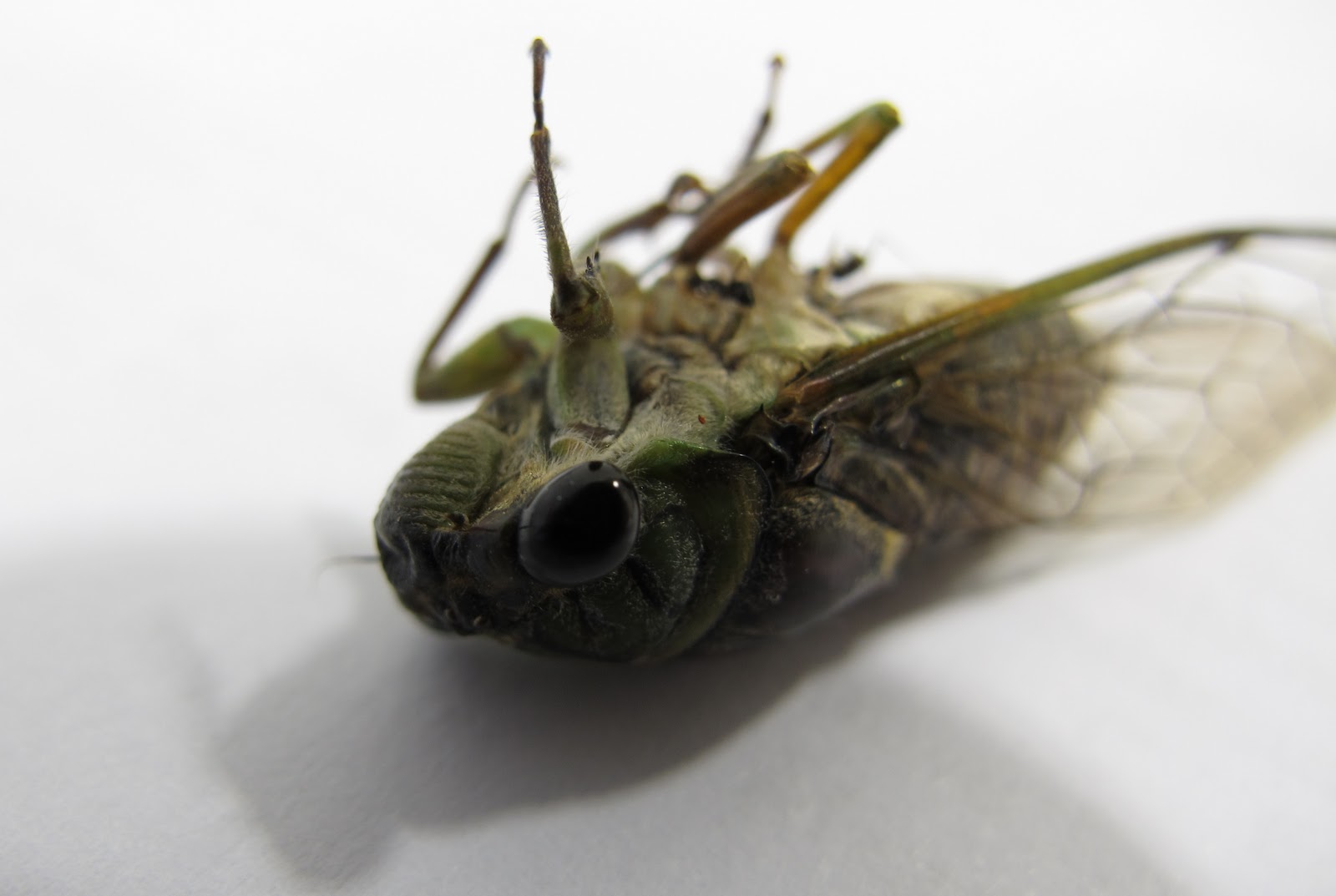
A cicada? The corpse was being explored by wee ants

These are larger ants than those represented by the out-of-focus individual mounting the cicada. They are seem to be building a house-like structure from the leaves of the plant.


Sunday, 8 January 2012

Brunei, Day 1. Bandar Seri Begawan

Well, first there was the usual (?) long distance (medium distance, in all honesty) air-travel craziness that's probably very familiar to many of you, but was novel for me. I eventually arrived in Bandar Seri Begawan, the capital of Brunei, via Singapore, on the Seventh of Jan. My bag came a day later.

Unlike Singapore, when I was sitting outside the Brunei airport today waiting for my luggage to arrive, I experienced that thrilling feeling of being other. English subtended rather than over-topped the Brunei Malay and arabic signage and I was the only Pakeha in the seating. Before the incoming flight landed, I might have been the only Pakeha at the terminal.

Here is some photos & footage of a few critters and plants I've come across round the lodgings (University accommodation).

Below Mimosa pudica. A pan-tropical weed, but still entertaining. Found here infesting the lawn behind the tower block where I'm housed.


Here are the flowers:

Mimosa pudica

Next, a couple of random lizard pics. One group (the ones I've seen may be all the same species, for all I yet know) like hanging out on shrubs and trees. They have these really long, thin tails. I saw one holding their tail out at an angle to the trunk, and it was jerking gently in the wind. Coincidence or something more cunning?

They swivelled around the trunk in response to my movement

Random basking lizard. Same species as above? In any case it's a larger animal.


Finally, two dead, more-or-less unidentified beetles found in the stairwell.

Lateral view of Rhinoceros beetle (Dynastinae sp.). Male.
Anterior view of Rhinoceros beetle (Dynastinae sp.). Male. Amazing fore-claws and an almost sweet countenance.

Unkown beetle 1. Maybe a female Dynastinid?
The hind legs of Unknown beetle 1.


Monday, 19 December 2011

(Not) Spontaneous Generation

Spontaneous generation is a (once widely held) belief that organic matter contains a vital force that can spawn life from inanimate objects.

Spontaneous generation was first disproved in the case of macro (large) organisms when, in 1668, Francesco Redi debunked the idea that meat exposed to the environment could spontaneously generate maggots. He thought maggots arose from eggs laid on the meat by flies.

The following is a figure illustrating his experimental design (taken from here).

In the middle treatment, a piece of meat was overlaid with cheesecloth. The flies were able to lay the eggs into the cheesecloth and when this was removed no maggots developed. However, if the cheesecloth containing the eggs was placed on a fresh piece of meat, maggots developed, showing it was the eggs that "caused" maggots and not spontaneous generation.

In 1794 John Needham provided what he considered to be proof of the spontaneous generation (SG) of microorganisms, when he heat-treated chicken broth which later developed a thriving microbial community after being cooled, and left at a constant temperature.

Of course, the flask was exposed to air. When Lazzaro Spallanzani conducted the experiment again, this time modifying the design so that air was excluded from the heated broth, no microorganisms manifested. This is was not the end of the affair though, as proponents of SG countered that air was necessary to somehow activate the vital force. 

Pasteur put paid to SG about 100 years later (remember, this was in the late 1800's, not that long ago). First he demonstrated that air contained particulate matter bearing what looked suspiciously like microorganisms. Secondly, he demonstrated (creating the swan-necked flask in the process) that heated organic matter exposed to air only spawned microbial colonies if the particulate matter carried in the air was allowed to reach the organic matter. See figure below (also from here).

Both flasks are open to the air, but if the air is heated at the u-bend to kill microbes piggy-backing on dust particles no microbial colonies manifest. Air doesn't activate a vital force because, well, there ain't one....

Below is a photo of a 60L plastic tub in my backyard that contains a small population of Utricularia australis - an aquatic, carnivorous plant. Members of the genus are called commonly called bladderworts after their tiny suction traps. The bladderworts are, however, not the stars of this post. 

An outdoor aquarium for bladderworts. The small bottle with the green cap at the left is a DIY CO2 generator - increased dissolved CO2 gives submerged aquatic plants a boost for photosynthesis.

I made up the tank from scratch using peat, sand, some leaf matter and rainwater. I transplanted a few companion plants, the bladderworts themselves, and inoculated the tub with a jar of water from the lake of origin to provide a source of prey.

What I most certainly didn't put in the tank was this:

The wily "Corinichthyes"

... At least not knowingly, and not in their current form. My partner was the first person to spot them, about two days before this picture was taken. When told I was incredulous, something not helped by their habit of hiding at the bottom of the tub when approached. Eventually I spotted them, and it did indeed seem truly miraculous. 

They have been dubbed "Corinichthyes" pending further identification. Given the history of the lake where the bladderworts and water came from, I suspect they are a trout fry.

Friday, 4 November 2011

Crazy-pole in flower

Our resident Pittocaulon praecox or palo loco (crazy pole/tree) is flowering for the first time this year. The Latin translates as "pitch-stemmed early one."

The genus Pittocaulon has been recently split from Senecio, a whale of a genus still containing over 1200 species. Members of Senecio have a wide range of forms: arid zone succulents to aqautics; annuals to perrenials; climbers, trees and small shrubs.

Pittocaulon contains five species indigenous to central and southern Mexico. They are shrubs or small trees with broomsick/pole-like branches that lose their leaves during the dry season (or winter in cultivation here in NZ). Pittocaulon occur over a diverse range of habitats, from dry scrub at 3000 meters to dry tropical forest at 300 meters. P. praecox has the widest range in the genus.

Both the Latin and common names refer to the phenology (specifically flowering) of P. praecox. In the wild the crazy-pole (as with some other members of Pittocaulon) flowers at the end of a dry season when the flora is under severe water stress, well before any of the other associated plants. This seemingly risky investment  in early flowering ("early" = prior to the onset of rainfall) may give the crazy-pole an edge on its neighbours when it comes to competing for pollinator attention; Being the only show in town presumably bolsters patronage. I don't imaging insects are particularly abundant at this time of year either, but if exclusive access to pollinators really has driven selection for early flowering, then the book-keeping should work out in the crazy-pole's favour.

*Medicore plant-porn to follow*

Apologies for the mediocrity of some of the following pics. This plant is really hard to satisfactorily photograph without some kind of rudimentary studio set-up, which i do not possess.


Crazy-pole at the beginning of flowering
 

The following photos chart the emergence of the inflorescence, a corymb.


The next sequence shows the opening of  a single P. praecox capitulum. Capitula are a type of psuedanthia (false flowers) unique to the sunflower family (Asteraceae). At the edge of the capitulum, the conspicuous "petals" are actually ray florets - individual, bi-laterally symmetric, unisexual (female) flowers. The "petal" of a ray floret is actually a ligule - formed by the fusion of 3 petals. The remaining 2 petals are inconspicuous. At the centre of the capitulum is a cluster of disk florets - radially symmetric, bisexual flowers with 5 tiny petals fused into a corolla.


Below is a cross section of a capitulum. Immature disk florets in the centre appear submerged in a forest of white bristles. These bristles are acutally the modified sepals of both types of floret. The sepals of a flower/floret are collectively called a caylx. In the case of the (many members of?) sunflower family the caylx has become a papus (pl. = pappi). Pappi aid in wind dispersal of the seeds.

Cross section through a capitulum.

The next 2 pics are of a ray floret. The papus (modified caylx) is obvious in the second picture. The two-lobed structure is the style (part of the female reproductive structures). Stamen (male reproductive structures) are absent.

Ray floret. The petal-like structure is a ligule made of 3 fused petals

Ray floret. Papus is obvious from this angle


Below are disk florets. The five lobes of the corolla are visible. In one of the florets (pictured alone to the right) you can see the style emerging from a theca - a sheath formed by the connate (fused together) stamina. 


Crazy-pole near the end of flowering

The crazy-pole commonly branches after flowering so by this time next year our resident one may start looking more candelabra-like.


First leaf appearing from the apex of a basal offshoot


Lastly, here are a few pics of another sunflower relative that finished its first flowering a few weeks ago. Senecio pendulus (syn. Kleinia pendula), the inch-worm plant, is a scrambling succulent originally from Yemen and NE Africa. Senecio = "old man", after the grey-white hairs of the pappus. Colour of the florets notwithstanding the disk florets are similar to P. praecox. Notice the lack of ray florets. The inflorescence also differs, with capitula being borne singularly on loooooong peduncles (infloresence stalks).

A Capitulum of Sencecio pendulus
Because of the compressed nature of a capitulum, the stalks of each floret have been reduced to, well, practically nothing and their bracts, that probably subtend each of those stalks in an ancestral species prior to the evolution of capitula, have grouped to form an involucre (pl. =involura ). To complete the resemblance of this false-flower to a real one they take on the aspect of a caylx of sepals! As with the P. praecox, the actual caylx of each individual floret has evolved into a pappus. The whitish, waxy coating you can see on the involucre in the picture to the left is one of a suite of adaptations to limit water loss (it also repels water).


Thursday, 13 October 2011

Random Garden (Chicken, Household) Update (2)

Lucretia is latest member of our chicken flock (hospice) to die. RIP Lucretia (Lucy). Lucretia was a Shaver Brown with plumage colour in reverse of our other shavers. She was an older hen whose eggs had characteristic rough, thin shells. She was (ultimately) killed by egg peritonitis, a nasty condition where the yolk of the egg is dislodged from the oviduct into the abdominal cavity causing a massive infection. Shavers are bred to be a super-layers who (so we are told by the vet) often suffer egg-laying related fatalities when they are older, instead of successfully undergoing chicken-menopause and dying of other age related complications.


At the end Lucretia was comfortable, warm, calm, and hydrated at the vet clinic; after determining there was nothing he could do for her, the vet gassed her to death behind closed doors in what we can only assume (and hope) was a humane way. We buried her under a tamarillo bush.

Interestingly, if you look at the background of the above photo you may notice  Plantago (plantain - but I'll call it Plantago to avoid common-name confusion with Musa species) under Lucretia's feet. I'm about 98% sure its Plantago lancelota - I haven't formally keyed it out.

Our chickens have destroyed all forms of greenery within their domain except the Plantago which they will not touch (we supplement them daily with plenty of additional greens from the gardens and property).

As a result Plantago is spreading rapidly throughout their enclosure - the chickens are structuring the plant-community composition within the pen. In terms of food-web theory this would be considered top-down control on plant-community composition by the chickens.

The chickens are inadvertently selecting for the Plantago (more precisely the mechanism and ultimately alleles responsible for its unpalatability). Should a mutant Plantago arise that lacks this chemical and/or structural defense against chicken-browse (and should the chickens decide to sample it) it will be toast. Whatever alleles are responsible for the characters making Plantago inedible are probaly undergoing stabilising selection. At one end alleles resulting in a reduction of unpalatability would be purified by the chickens - those plants (allele sacks) wouldn't live long enough to pass on said alleles to the next generation. At the other end alleles resulting in more extreme (but unnecessary) amounts of defence might involve a resource-allocation based trade-off that would leave those plants at a disadvantage with their con-specifics.

If  some other plant species equally unpalatable to chickens disperses into the pen its frequency may also continue to increase - but that would be determined by its ability to effectively compete with the established Plantago for resources (light, nutrients, space).

Over a much, much longer time period (assuming the chickens continued their brand of top-down control)  other cool interactions could occur: Forms of unrelated plants resembling Plantago might arise (mimicry). Chickens with a taste for/ability to utilise Plantago might also arise (if we added a rooster or two), giving them an advantage over chickens with more restricted diets.


Random Garden Update (1)

Lately I have been abandoning posts about two paragraphs in, because:

1) I get bored and think, why be bothered, a generally interested person could get all they need on this topic via Wikipedia.

2) I realise the idea is too complicated to communicate in a blog format and what I'm actually doing is using the blog to consolidate my own thinking on the issue - which is fine for me, but for a hypothetical reader the results are... not particularly... coherent.

So in an attempt to get back in to the swing of blogging practice i offer/subject you, the reader, to the blogging equivalent of a rant about last nights dream or a tour through a family photograph album.

We have been receiving springtime visits to our home garden from Kererū (Hemiphaga novaeseelandiae), a wood pigeon indigenous to New Zealand. The other evening there were five of these birds up in the plum trees.


Unfortunately, the Kererū are not visiting in order to service our viewing pleasure, they are after food - specifically plum blossoms. This is troubling as for every blossom they feast upon, we lose a potential plum and five beautiful Kererū can demolish a lot of plum blossoms in a week-long course of both morning and evening visits.